FIELD NOTES / Quantum Physics
The Clock Inside Us
I find it strange that my body can keep time without me paying attention. I can lose track of an afternoon, yet somewhere inside me, cells are carrying on with their daily routines. That is what first drew me to the genetic clock.
The basic idea is surprisingly easy to understand. Certain genes help produce proteins that gradually build up inside a cell. These proteins then slow down the process that made them. As they break down, the process starts again. Together with other controls, this creates a cycle lasting roughly twenty-four hours. Daylight helps keep our internal rhythms aligned with the day outside.
I keep thinking about that connection. The Earth turns, day becomes night, and living things have evolved a way to anticipate the change. Something as familiar as feeling ready for bed has a history written into the workings of our cells.
But the time we feel is much less regular.
A few minutes spent waiting for an important answer can feel painfully long. An hour of conversation can disappear before we notice it. We can wake from sleep with almost no sense of the hours that passed. Our experience of time depends on what is happening within us.
That made me wonder whether the machinery that helps our bodies follow the day might also influence how we experience a moment.
My interest in quantum consciousness grew out of that question. Quantum physics describes how matter behaves at very small scales. Roger Penrose and Stuart Hameroff have proposed that quantum processes in tiny structures inside brain cells could give rise to moments of awareness. Their proposal, known as Orch OR, remains unproven, but I find the question behind it compelling: what physical process makes an experience feel like something? Their account of the theory explores that possibility.
At first, I pictured a connection between two very different rhythms. The genetic clock moves through a cycle lasting about a day. The processes involved in perception happen much faster. Perhaps the slower rhythm helps set the conditions in which those faster processes work.
A protein called cryptochrome made the possibility especially interesting to me. Members of this protein family help regulate the body clock. Researchers have also studied a different member of the family in migratory birds, where the behaviour of electrons could help explain sensitivity to magnetic fields. Experiments with purified robin cryptochrome found that its light-driven chemistry responded to magnetic fields. That gives quantum physics a specific role to investigate in biology. Xu and colleagues
There is a limit to what I can take from this. The bird protein studied in those experiments differs from the cryptochromes that regulate the human clock. A result involving a bird protein does not establish how consciousness works in a person. Still, it gives me a more concrete starting point than simply assuming that two fascinating subjects must be connected.
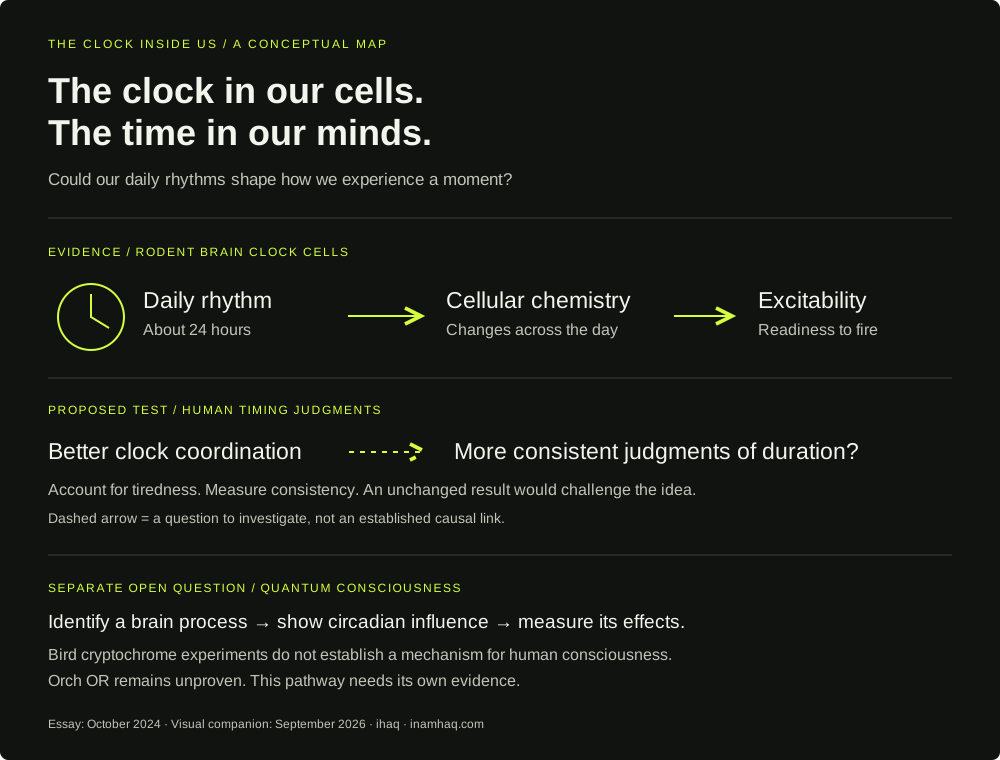
The idea I would now put forward is fairly simple: our daily biological rhythms may change the conditions under which the brain processes time.
There is some groundwork for this. In studies of the brain’s central clock in rodents, daily changes in cellular chemistry influenced how readily nerve cells became electrically active. A slow daily rhythm could therefore affect much faster activity in a cell. Whether that pathway influences our sense of duration remains a question to test. Wang and colleagues
I also think I need to be careful about what I mean by “experiencing time.” Noticing two sounds close together, judging how long a minute lasts, and remembering an afternoon are different tasks. A frightening event might feel long in memory without the brain having taken in more detail during it. A useful theory should explain these differences.
One possibility I would like to test is whether poor coordination between local biological clocks makes our timing judgments less consistent, even after accounting for tiredness. If restoring that coordination restored consistency, it would give the idea some support. If timing stayed unchanged, I would need to rethink it.
The quantum part needs its own evidence. We would have to identify a particular process in brain cells, show how the body’s daily rhythms affect it, and measure what difference it makes to brain activity. Finding that effect would still leave the larger question of consciousness open.
I remain fascinated because there is already something remarkable here. Our cells can sustain a daily rhythm. Our minds can turn a few minutes into a wait that feels endless. Somewhere between those observations are mechanisms we can investigate.
I want to understand how much the clock in our cells has to do with the time we feel passing.